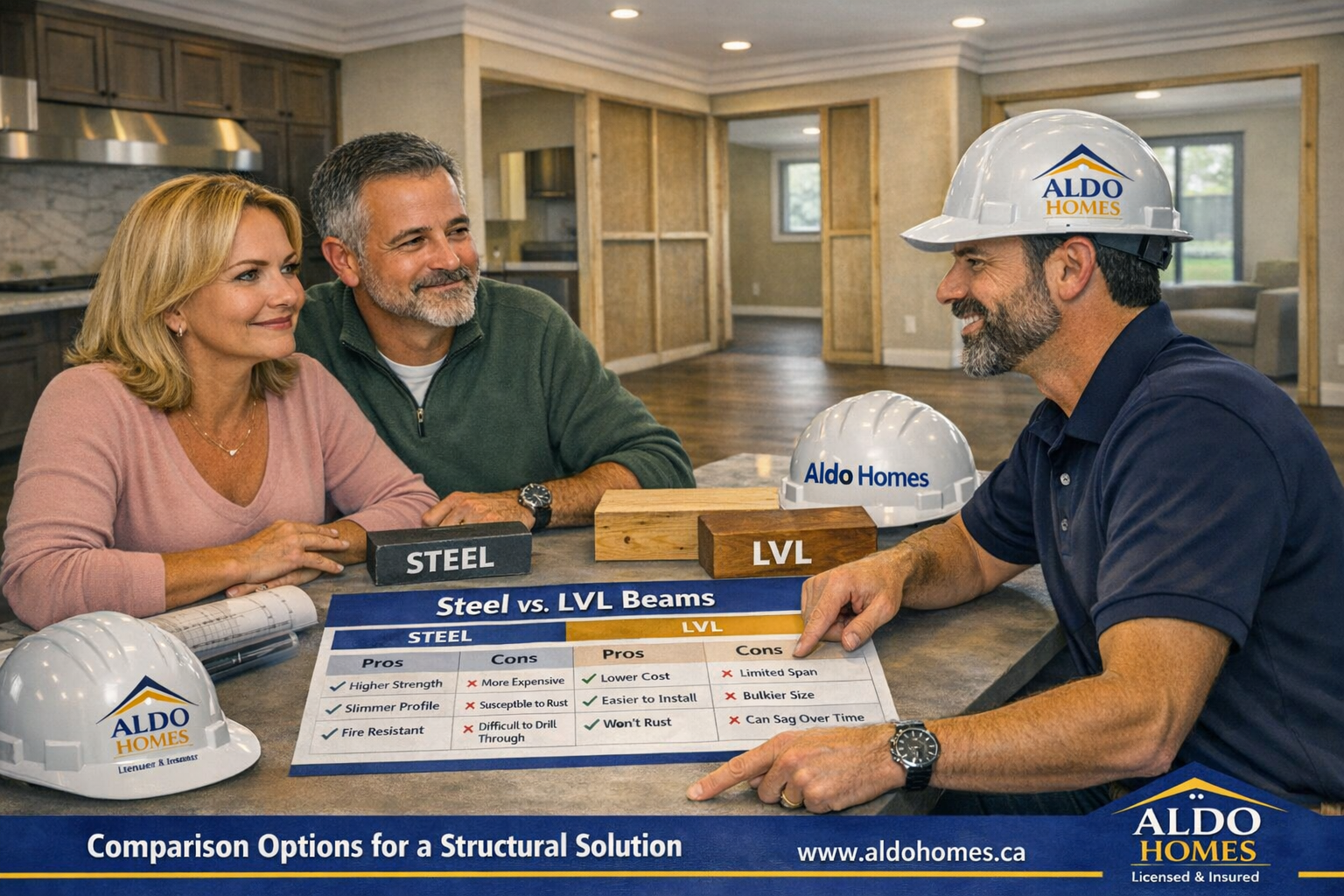
Designing the right structural solution is one of the most critical steps in any major renovation, especially when creating an open concept layout or removing a load-bearing wall. While homeowners don’t select the beam(s) themselves, understanding the differences between LVL, steel, and flitch beams helps them evaluate the options presented by engineers and contractors. This knowledge empowers homeowners to recognize why certain solutions are recommended, how they affect strength and vibration control, how they impact design and floor plan layout, and what long-term performance they can expect from their renovation.
This guide is tailored for homeowners who value clarity, durability, and a renovation process grounded in engineering accuracy. We break down the pros and cons of each beam type, explain how span length and structural loads influence the design, and outline the technical considerations that determine which solution is appropriate for a given home. Homeowners who appreciate thoughtful planning, predictable outcomes, and high-quality structural work benefit most from understanding these distinctions early in the process — not to make the decision themselves, but to confidently understand the one being made for them.
At Aldo Homes, we guide you through these decisions with a structured, transparent approach. Our team evaluates the existing framing skeleton of your house, collaborates with partner engineers, and designs structural solutions that align with your goals — whether you’re opening up a main floor, removing posts, or achieving a flush, modern ceiling line. For homeowners seeking a reliable, fully insured, high-end renovation partner, we provide the expertise and coordination needed to deliver a structurally sound, visually seamless result.
📘 Table of Contents
🛠️ 2. Structural Steel Beams: Pros and Cons
🪵 3. Flitch Beams: The Hybrid Option
📊 4. Steel vs. LVL vs. Flitch — Comparison Table
🧭 5. Summary: Which Beam Should You Choose?
One of the most common questions we hear from homeowners is: “Can we use an LVL beam instead of steel to save money?” The honest answer is: “it depends” — on span length, load requirements, joist depth, vibration tolerance, and the final look you want. Below, we break down the pros and cons of LVL, steel, and flitch beams, with the technical details you need to make an informed decision together with us.
🌲 LVL Beams: Pros and Cons
A practical option for short spans — but with important structural limitations. Laminated Veneer Lumber (LVL) is created by bonding thin, rotary peeled wood veneers under heat and pressure with structural resin. This process makes LVL stronger and more stable than conventional spruce lumber, but still less rigid and less load-resistant than steel.
⭐ Top 5 LVL Beam Pros (With Technical Detail)
- Cost-effective for short spans. LVLs perform well for spans up to 10 feet. Beyond that, the required depth increases significantly.
- Simple installation: LVL beams can be installed by basic framing crews using standard carpentry tools—no welding, cranes, or steel fabrication equipment required. Because LVLs are straightforward and profitable for entry-level contractors, many beginners naturally gravitate toward recommending them. However, this convenience does not always align with the homeowner’s long-term structural needs, especially when spans, vibration control, or flush ceiling designs are involved.
- Lightweight and easy to maneuver. This reduces labour time and makes LVLs accessible for beginner contractors.
- Effective for small openings. For example, with 2×8 floor joists, a 4 ply LVL (1¾” × 7¼”) can often carry the load for spans under 10 feet—as long as it is bolted with ½” bolts in a zigzag pattern at 16” on center.
- Lower upfront material and labour cost. LVL beams and their typical supports (2×4 or 2×6 spruce posts) are inexpensive compared to steel.
⚠️ Top 5 LVL Beam Cons (With Technical Detail)
1. Beam depth and point load alignment — The desired beam size can have several implications, for example, in depth and point load alignment. Bulky beam sizes will be needed for spans more than 10 feet: LVLs often need to be 12–16 inches deep. This creates three major issues:
- They cannot be installed flush with 2×8 or 2×10 joists
- They force a bulkhead, reducing ceiling height and disrupting the open concept look
- The short beam size makes it difficult to align the point load to the existing posts and footings in the basement
2. Higher vibration levels — LVLs flex more than steel. This can cause:
- Noticeable floor vibration
- Ceiling cracks
- Tile cracking in upstairs bathrooms
3. Long-term structural sagging
- Wood posts can shrink or rot
- LVLs are usually supported by spruce posts that can shrink or deteriorate over time.
4. Limited ability to accommodate plumbing/electrical
- LVLs cannot safely accommodate large holes for drainpipes or wiring.
5. Long-term performance concerns
- While LVLs may save money upfront, they can introduce issues that cost more to correct later.
🛠️ Structural Steel Beams: Pros and Cons
The strongest, most stable, and most versatile option for major structural renovations.
Steel beams — often referred to as I beams or W beams — are engineered to carry heavy loads over long spans with minimal deflection.
⭐ Top 5 Steel Beam Pros (With Technical Detail)
- Superior strength for long spans. Steel handles long, open concept spans effortlessly.
- Flush installation for a clean, modern look. Steel beams can be installed flush with existing joists.
- Minimal vibration. Steel’s rigidity dramatically reduces floor movement.
- Greater flexibility for mechanical systems. With proper reinforcement, steel beams can accommodate 2-inch holes for plumbing or electrical.
- Lifetime durability: Steel beams paired with steel posts will not shrink, rot, or warp.
⚠️ Top 5 Steel Beam Cons (With Technical Detail)
- Higher project implementation cost: requires cranes, forklifts, fabrication, and specialized labour.
- More complex installation: Steel requires professional handling and precise measurements.
- Heavier and harder to maneuver: Often requires coordinated lifting and staging.
- Longer lead times: Steel fabrication and delivery may take longer.
- Higher engineering requirements: Steel solutions must be designed with precise load calculations and connection details.
🪵➕🛠️ Flitch Beams: The Hybrid Option
A flitch beam is a hybrid beam made by “sandwiching” a ½” up to 1” thick steel plate between two LVL plies, and it can be very useful in specific cases.
When Flitch Beams Make Sense
- When you need more strength than LVL but don’t require full steel
- When the span is short to moderate
- When vibration control matters
- When limited drilling flexibility is needed (up to 2” pipe)
Limitations of Flitch Beams
- Cannot match the span capacity of steel
- Heavier and more expensive than LVLs
- Often cannot be installed flush
- Require precise engineering and bolting
- Require technical skill to assemble
Flitch beams are a clever solution — but only for specific structural scenarios.
📊 Steel vs. LVL vs. Flitch — Comparison Table
\
\
\
\
\
\
\
\
\
\
\
\
\
\
\
\
\
\
\
\
\
\
\
\
\
\
\
\
\
\
\
\
\
\
\
\
| Feature | LVL Beam | Steel Beam | Flitch Beam |
|---|---|---|---|
| Span Capacity | Short spans (under 10 ft) | Long spans (10–25+ ft) | Moderate spans |
| Flush Installation | Rarely possible | Easily achievable | Sometimes possible |
| Vibration Control | Low | Excellent | Moderate |
| Drilling for Plumbing/Electrical | Very limited | Up to 2” with reinforcement | Limited but better than LVL |
| Material Cost | Low | High | Medium |
| Labour Complexity | Low | High | Medium |
| Long Term Durability | Moderate | Excellent | Good |
| Best Use Case | Small openings | Open concept layouts | Mid range structural needs |
🧭 Summary: Which Beam Should You Choose?
- For spans under 10 feet, LVL may be a cost-effective option.
- For spans over 10 feet, steel is almost always the better choice.
- For flush ceilings and open concept layouts, steel is the only reliable solution.
- For moderate spans where LVL isn’t enough, flitch beams can be a smart hybrid option.
- For long-term durability and vibration control, steel outperforms both LVL and flitch beams.
At Aldo Homes, most of our structural solutions use steel because our clients want the strongest, safest, and most visually appealing outcome. And the more complex the project, the more value our expertise brings.
❓ FAQ
Why are LVL beams generally limited to spans under 10 feet?
LVLs often require much greater depth once spans exceed 10 feet, depending on the specific loads in a home. This increased depth leads to bulkheads, difficulty aligning point loads with existing posts and footings, and other installation limitations. In addition, the building code does not allow more than four LVL plies to be fastened together, further limiting the load an LVL beam can safely carry.Why can’t LVL beams be installed flush with standard 2×8 floor joists?
A 2×8 floor joist is only 7¼″ deep, while LVLs designed to carry heavier loads — such as those from a 20-foot opening — typically need to be 12–16 inches deep. Because the LVL is far deeper than the joist, it cannot sit flush within the floor system, forcing a bulkhead.What causes LVL-supported floors to vibrate more than steel-supported floors?
LVLs flex more than steel under load. This increased deflection can result in noticeable floor vibration and may contribute to ceiling or tile cracking over time.Why are steel beams the best option for open concept layouts?
Steel beams can span 10–25+ feet with minimal deflection and can be installed flush with existing joists, creating a clean, uninterrupted ceiling line. Steel can also be reinforced or doubled up when additional strength is required. At Aldo Homes, we have engineered, fabricated, delivered, and successfully installed flush steel beam structures, achieving a 30 ft × 20 ft opening perfectly flush with 2×8 floor joists and without posts on the main floor.Can LVL beams accommodate plumbing or electrical holes?
LVLs cannot be drilled to accept large openings for plumbing or wiring. A standard 1½″ drainpipe requires a 2″ hole, which removes nearly one third of a 7¼″ LVL’s depth. Building code does not permit holes of that size in wood beams. Steel beams, however, can be reinforced with additional steel plates to safely accommodate a 2″ opening while maintaining structural integrity.Why do steel beams reduce vibration compared to LVLs?
Steel is significantly more rigid than wood, which minimizes floor movement and reduces vibration throughout the structure.When is a flitch beam a better choice than LVL?
A flitch beam is a good option when an LVL alone is not strong enough, but a full steel beam is unnecessary. For example, a flitch assembly using 2 or 4 plies of 1¾″ LVL combined with one or two 1″ thick, 7″ wide steel plates can allow for a 2″ hole to pass a drainpipe while still providing greater strength and stiffness than LVL on its own.Why do flitch beams require precise engineering?
Flitch beams rely on accurately calculated load-carrying capacity, correct bolt spacing, proper steel plate sizing, and the interaction between the steel and LVL components. Because the performance of the beam depends on all of these elements working together, flitch assemblies require precise engineering and skilled installation.Why do steel beams require specialized labour?
Steel installation involves cranes or lifting equipment, fabrication, precise measurements, and specialized tools. These factors require trained professionals experienced in steel handling.Why might LVL posts deteriorate over time?
Spruce posts commonly used to support LVLs can shrink or rot over time. Both LVLs and spruce posts are also vulnerable to termite damage, unlike steel beams and HSS steel posts.📚 Sources
\
\
\
\
\
\
\
\
\
\
\
\
\
\
\
\
\
\
\
\
\
\
\
\
| Topic Referenced | Source Type | Link |
|---|---|---|
| LVL structural characteristics | APA – The Engineered Wood Association | https://www.apawood.org/structural-composite-lumber#laminated-veneer-lumber |
| Steel beam load capacity & engineering | Canadian Institute of Steel Construction (CISC) | https://www.cisc-icca.ca |
| Floor vibration & deflection standards | Canadian Wood Council | https://cwc.ca |
| Building materials durability | CMHC – Canadian Mortgage and Housing Corporation | https://www.cmhc-schl.gc.ca |
| Plumbing/electrical drilling limitations in wood | Ontario Building Code (OBC) guidelines | https://www.ontario.ca/laws/regulation/120332 |
| Steel installation requirements | WorkSafe BC / CSA steel handling guidelines | https://www.worksafebc.com |
| Hybrid beam assemblies (flitch beams) | Canadian Wood Council Technical Resources | https://cwc.ca |
⚖️ Disclaimer
© 2026 Aldo Homes. This guide provides general information only and may not reflect all project-specific requirements. Structural beam selection must be assessed and engineered by qualified professionals. If you’re planning a structural renovation and want a reliable, fully insured team to guide the process, Aldo Homes is available to review your plans.