Steel Beams in Your Home: What GTA Homeowners Need to Know
Most homeowners only think about finishes — the kitchen, the flooring, the layout — but the real success of any renovation begins with the structure you don’t see. Steel beams, engineered load paths, proper footings, and accurate drawings determine whether your home remains safe, stable, and problem-free for decades. When a load-bearing wall is removed, the new beam becomes the backbone of the house. If it’s undersized, poorly supported, or installed without proper engineering, the consequences are serious: sagging floors, cracked finishes, shifting walls, and long-term structural deformation. Structural steel beams carry the loads from floors, walls, roofs, and point loads above.
This section is essential reading for any homeowner planning an open concept renovation, basement beam replacement, large patio door opening, or second-storey addition. Ontario’s Building Code requires a licensed structural engineer for a reason — the minimum code requirements are only the starting point, and older GTA homes often hide structural surprises. Understanding the basics helps you recognize whether your contractor is doing things correctly, whether the engineering makes sense, and whether your home is being reinforced to a standard that protects your investment. Most structural failures in older GTA homes come from undersized beams, missing blockings, misaligned point loads, and inadequate footings.
By learning how beams are sized, where steel is used, how to read a structural drawing, and how to understand what the engineer has designed versus what the contractor must implement, you gain the clarity to make informed decisions, avoid costly mistakes, and ensure your renovation is built on a foundation of safety and long-term performance. This knowledge empowers you to ask the right questions, verify the right details, and choose a contractor who prioritizes structural integrity — not shortcuts.
Table of Contents
📋 2. Why Engineering Is Mandatory
🏠 3. Where Steel Beams Are Used in GTA Homes
🛠️ 4. Types of Steel Beams Used in Residential Construction
📄 5. Understanding Your Engineering Report
🧮 6. How Structural Engineers Determine the Right Beam Size
❓ 7. FAQ
⭐ 8. Summary
📚 9. Sources
Why Steel Beams Matter in Home Renovations
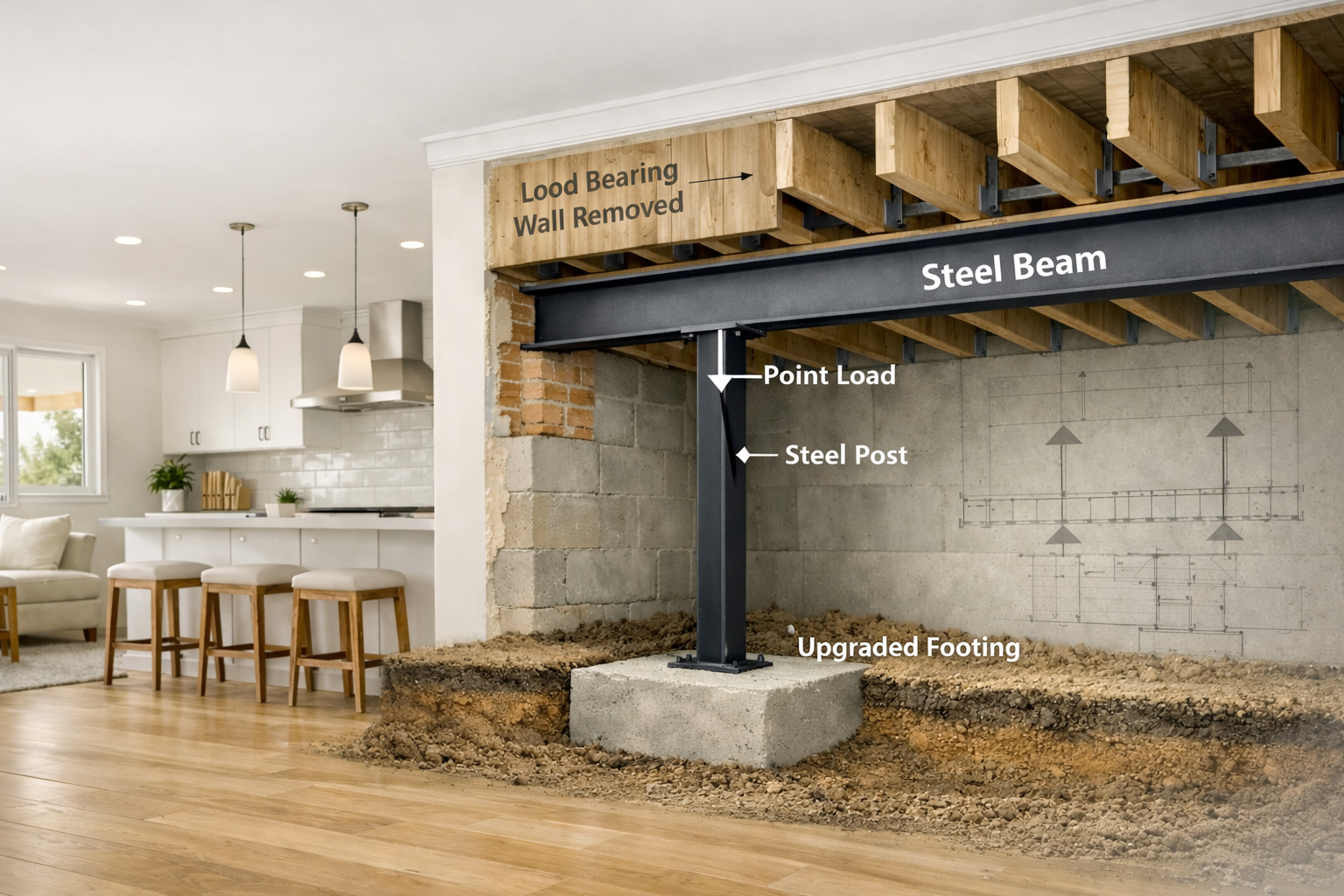
Steel beams carry the weight of floors, walls, roofs, and point loads from above. When a load bearing wall is removed, the beam becomes the new structural support system.
Steel beams are used when homeowners want:
- Open concept kitchens and living rooms
- Larger patio door or window openings
- Basement post removal (wooden or cinder block) or wooden beams replacement.
- Second-storey additions
- Full rear wall openings with glass systems
A properly designed and installed beam ensures:
- No sagging
- No cracked finishes
- No bouncy floors
- No long-term structural issues
Why Engineering Is Mandatory
Ontario’s Building Code requires a licensed structural engineer to design any beam that replaces a load bearing wall.
Important note: the Building Code parameters are the bare minimum required for a project. We always advise increasing the strength of each structure to be installed.
Engineering ensures:
- Correct beam size
- Correct steel grade
- Proper bearing length
- Adequate footings
- Safe temporary shoring
- Proper joist connections
- Compliance with OBC Part 9 or Part 4
Most structural failures in older GTA homes come from:
- Undersized beams
- Missing posts, or blocking between floor joists.
- Misaligned point load transfer from the beam to the ground
- Inadequate footings, size and depth or missing rebar in it
- Incorrect assumptions about joist direction
- Unverified steel quality
Where Steel Beams Are Used in GTA Homes
Open concept main floors
- Removing one or more load bearing walls.
Basement beam replacements
- Replacing old wooden beams or old and large posts (cinder block, brick, or wooden)
- New beams and posts are often required when underpinning (basement floor-lowering projects)
Large window/patio door openings
- Supporting exterior brick envelope, interior framing, and roof loads.
Additions and second-storey builds
- Carrying the loads of new floor, walls and roof systems.
Types of Steel Beams Used in Residential Construction
W Shape (Wide Flange) Beams
- W shape beams are the most common structural steel beams used in residential renovations across the GTA.
- They are efficient, strong, and available in both metric (W150, W200, W250, W310) and imperial (W6, W8, W10, W12) designations.
How W beam sizing works
A W beam designation has two numbers:
- First number = height of the beam
- Second number = weight per linear foot
Example: A W6×15 beam is:
- 6 inches tall
- 15 pounds per foot
Why this matters for homeowners
- The height determines whether the beam can fit flush inside a floor cavity.
- The weight affects the strength, stiffness, and width of the flanges.
- Heavier beams of the same height have thicker flanges and webs, making them stronger.
Example: W6 beams
-
W6×15 → lighter, narrower, used for short spans
-
W6×20 → stronger, wider flanges
-
W6×25 → strongest W6 beam, approx. 6” tall × 6” wide
- Fits perfectly between 7¼” (actual) 2×8 joists
- Ideal for flush installations
- Often requires reinforcement for long spans or heavy loads
Comparison Table (Heights Only)
| Imperial Size (W Series) | Metric Equivalent (W Series) | Weight Range (lb/ft) | Typical Residential Use |
|---|---|---|---|
| W6 (≈ 6" height) | W150 | 9–25 lb/ft | Ideal for flush beams in 2×8 joist systems. Suitable for short spans and small wall removals (typically under 10–15 ft). The W6×25 is the strongest in this group and fits perfectly inside a 7¼" joist cavity, making it the preferred choice when homeowners want a completely flat ceiling. |
| W8 (≈ 8" height) | W200 | 10–67 lb/ft | Excellent for medium spans (15–20 ft) and commonly used for main floor wall removals. Works well when carrying second floor loads or when a flush installation is not required. Fits cleanly within 2×10 joists (9½" actual) and offers a wide strength range (up to 67 lb/ft). A strong option for basement beams, as the 8" depth aligns well with HVAC ductwork. |
| W10 (≈ 10" height) | W250 | 12–112 lb/ft | Designed for longer spans (20–25 ft) and heavier loads such as second floors + roof loads. Ideal for large open concept layouts with fewer posts. Due to its height, a W10 beam is rarely installed flush unless the home has deep joists (2×12 or engineered joists). |
| W12 (≈ 12" height) | W310 | 14–136 lb/ft | Used for heavy loads and long spans, including rear wall removals, large structural openings, and situations where the beam must support multiple floors or concentrated point loads from additions. Typically installed as a dropped beam due to its depth. |
Other structural steel elements in your home
HSS (Hollow Structural Sections)
Used for:
- Posts
- Columns
- Architectural elements
Common HSS post types
- Round: 3½” diameter, with thickness ranging from 3/16”– ¼” - ⅜” thick (the OBC minimum is 3/16”)
- Square: 4×4, 5×5, 6×6
- Rectangular: Used when a wider bearing point is needed (to support 2 beams ends at once)
Channels (C Shapes)
Used for:
- Reinforcing existing beams. For example, a 5” C channel fits inside a W6×25 web for reinforcement.
- Smaller openings
- Composite assemblies.
Angles (L Shapes)
- Used as lintels over windows and doors. For example, when enlarging or creating a new opening, we need to replace the lintel, add a moisture barrier between the new brick layer and the wall & lintel, and finalize with skilled brickwork.
Typical lintel sizes
- Small openings: L 3½ × 3½ × ¼
- Wider spans: L3 ½ ×5 ×¼ or L 3½ × 6 ×¼ (used for larger than 3 ft opening, up to 5ft wide opening)
Understanding Your Engineering Report
Load Bearing Wall
- Carries structural weight from above — typically floor joists, roof loads, or another wall. Floor joists are perpendicular to the wall in question and can be overlapping (2 different boards towards each side) or continuous floor joists (see “Over Spanned Joists”)
- A wall that provides partial support even if joists appear continuous, or are changing direction on the other side of the wall.
- Why it matters: Removing it without a properly engineered beam can cause sagging floors, cracked drywall, sticking doors, and long term structural deformation.
- Criteria: floor joists (or roof trusses in a bungalow) are perpendicular on the wall in question. In some cases, the floor joists change direction, meaning that on a side of the wall they are parallel, while only the other size joists are sitting on the wall in question.
Partition Wall
- Non structural; divides rooms only.
- Why it matters: These walls can be removed without structural reinforcement — but only after confirming they don’t hide a plumbing stack, HVAC trunk, or electrical bundle. City Inspectors usually ask for an engineering letter to confirm it.
- Criteria: ensure that the above floor joists are parallel to the partition wall on both sides.
- Example: a closet wall is often just a partition wall.
Shear Wall
- Provides side to side stability and prevents the house from racking during wind or lateral forces.
- Why it matters: Removing a shear wall without replacing its function can cause the house to sway, crack, or shift over time.
- Example: Narrow Toronto semis often rely on interior shear walls for lateral stability because the exterior walls have many windows.
Over Spanned Joists
- Joists that exceed the maximum allowable span once a wall is removed.
- Why it matters: Floors become bouncy, ceilings crack, and long term sagging occurs.
- Example: A 2×8 joist spanning more than ~11’ 9” becomes over spanned if the supporting wall is removed.
- Solution: depending on the length, the floor joists can be sintered (up to total length of 11’ 9”) or a structural beam should be installed to support the load above.
Transfer Beam
- A beam installed perpendicular to another beam to redirect loads to a different location (T-shape structure)
- Why it matters: Allows for a completely open concept when posts cannot be placed in the desired layout.
Flush Beam vs Dropped Beam
Flush Beam: Installed inside the floor cavity; creates a flat ceiling.
- Requires cutting joists and installing engineered hangers
- Often requires rerouting plumbing, HVAC, or electrical
- More labour intensive.
- A flush beam is ideal for modern open concept spaces combining custom kitchens and living rooms.
Dropped Beam: Installed below the ceiling; creates a bulkhead.
- Faster, more economical
- Often a practical option for basements because the HVAC duct work creates a bulkhead anyway.
Sistering Joists
- Strengthening joists by adding new lumber (spruce) or LVLs beside existing ones. Engineering design must provide technical specs for the contractor to follow, such as pattern and size of nailing, bolting, and gluing.
- Why it matters: Required when removing a wall causes joists to become over spanned or when joists are damaged.
- Applicability: Sistering is often needed in old homes basements, or on main floors where floor joists need to be extended to reach the newly installed beam. Another example can include applications near stair openings where joists are already weakened by headers and trimmers.
Footings
- Concrete pads that support posts and beams by transferring loads to the ground.
- Why it matters: If a new post lands on a thin basement slab, the slab will crack — a proper footing must be poured.
- Example: A 20 ft steel beam often requires a 3ft × 3ft ×2 ft footing under each post. Footings require 15mm rebar, square shape, 6” apart. Rebar needs to be installed halfway inside the concrete and ensure the ends do not touch the perimeter, because soil humidity will cause the steel to rust, even if inside the concrete.
Shear Frame / Moment Frame
- A rigid steel frame is installed around large openings (e.g., full wall of windows or sliding doors).
- Why it matters: Provides both vertical support and lateral resistance when most of the wall is removed.
- Example: A 16 ft patio door with minimal side walls often requires a steel moment frame to prevent racking.
Point Load
- A concentrated load that must land on a post or footing.
- Why it matters: If a point load lands on a weak spot (e.g., hollow block or thin slab), structural failure can occur.
- Example: The end of a steel beam carrying a second floor is a major point load. If the steel post is not installed directly on the foundation concrete, a “blocking” must be installed to ensure continuous load transfer to the foundation or post & footing below.
Bearing Length
- The amount of beam sitting on a post or wall.
- Why it matters: Too little bearing causes crushing or slipping.
- Example: The minimum bearing on each end is 3 ½” (the size of a 2x4 wall or of a HSS round post).
Deflection Criteria
- The maximum amount a beam is allowed to bend under load.
- Why it matters: Even if a beam is “strong enough,” excessive deflection causes cracked tiles, uneven floors, and drywall issues.
- Important note: the Building Code reflects the minimum legally accepted; it is not the best option for the given house or project. Stronger solutions are always recommended.
Lateral Bracing
- Prevents a beam from twisting under load.
- Why it matters: Unbraced beams can buckle even if they meet strength requirements.
- Example: Joists attached to the top flange of a steel beam act as lateral bracing.
Temporary Shoring
- A temporary support wall installed before removing the existing wall.
- Why it matters: Prevents sudden collapse during construction.
- Example: Aldo Homes installs custom-made engineered shoring walls on both sides of the existing wall before demolition.
Mill Test Report (MTR)
- A document verifying the steel’s chemical composition, grade, and origin.
- Why it matters: Confirms the beam meets the engineer’s specification and is not “mystery steel.”
CWB Certified Welding
- Structural welding performed by welders certified by the Canadian Welding Bureau.
- Why it matters: Ensures welds meet CSA standards and are safe for structural loads.
- Example: Aldo Homes works only with welders certified in SMAW/FCAW.
How Structural Engineers Determine the Right Beam Size
Most homeowners see a beam as “a big piece of steel,” but for engineers, beam sizing is a precise calculation that determines whether your home stays safe, level, and structurally sound for decades. Every beam design is based on measurable forces, load paths, and safety limits — not guesswork, not rules of thumb, and definitely not contractor opinion.
To size a beam correctly, engineers must understand what loads the beam will carry, how those loads behave, and how they combine under real-world conditions. Below is a deeper explanation of what engineers actually calculate and why each factor matters.
Structural Load Types (What the Beam Must Carry)
Before any math begins, engineers categorize all forces acting on the structure. These loads are grouped by direction — vertical (gravity) or horizontal (lateral) — and by whether they are constant or variable.
Dead Loads (D)
Permanent, static weight of the structure itself:
- Framing
- Drywall
- Flooring
- Roofing
- Brick
- Mechanical systems
These loads never change. They form the baseline weight the beam must support.
Live Loads (L)
Also called imposed loads, these are temporary and movable:
- People
- Furniture
- Appliances
- Future renovations
Building codes (e.g., ASCE 7) assign typical values such as 40 psf for residential floors.
Environmental Loads
These vary by location and are critical for exterior walls, additions, and roof supporting beams.
- Wind Loads (W) — lateral pressure from wind
- Snow Loads (S) — vertical weight of accumulated snow/ice
- Seismic Loads (E) — side-to-side forces from ground motion
Other Specialized Loads
Less common in residential work but still part of engineering principles:
- Hydrostatic & Soil Pressure (H) — forces against foundation walls
- Impact Loads — dynamic forces from sudden movement
- Thermal Loads — expansion/contraction from temperature changes
Load Combinations
Engineers never look at loads individually. They combine them to simulate worst-case scenarios, such as:
- Heavy snow + high wind
- Live load + dead load + seismic event
- Snow load + wind uplift
This ensures the beam is safe under every possible condition, not just ideal ones.
Span Length
This is the distance the beam must cover without support. Longer spans require stronger, deeper, or heavier beams because load increases exponentially with distance.
Why it matters: A beam that is too small will sag, crack drywall, cause bouncy floors, and create long term structural deformation.
Tributary Area (What Portion of the House the Beam Supports)
The tributary area is the total area of the house that the beam is responsible for holding up — including floors, walls, furniture, people, and sometimes roof loads.
Engineers calculate
- The square footage supported by the beam
- The weight of materials above (dead load)
- The expected weight from people and furniture (live load)
- Whether loads are uniform or concentrated
- How much load transfers to perimeter walls vs. the beam
- How environmental loads interact with the structure
- How all loads combine under worst case scenarios
Why it matters: Two beams of the same length may require completely different sizes depending on what they are carrying.
Uniform Load vs. Point Load
Uniform Load
Evenly distributed weight (e.g., floor joists).
Point Load
A concentrated force at one spot (e.g., a post from a second floor wall or roof truss).
Point loads often require:
- Larger beams
- Additional posts
- Larger footings
- Reinforced load paths
Why it matters: If a point load is not properly transferred to the ground, the structure can fail — especially in older GTA homes where previous renovations altered load paths.
Deflection Limits (How Much the Beam Can Bend)
Even strong beams bend slightly under load. Engineers calculate the maximum allowable deflection so floors stay stiff and finishes don’t crack.
A stronger beam reduces:
- Floor bounce
- Tile cracking
- Ceiling cracks
- Door misalignment
Why it matters: A beam can be “strong enough” by code but still cause cosmetic and functional issues if it deflects too much.
Lateral Bracing Requirements
Steel beams can twist if not properly braced. Floor joists attached to the top flange often act as bracing, but not always — especially in basements or flush installations.
Engineers determine:
- Whether the beam is braced
- How often must bracing occur
- Whether additional steel or blocking is required
Why it matters: An unbraced beam can buckle even if it meets strength requirements.
Older Homes Require Additional Investigation
Many GTA homes have:
- Previous renovations without permits
- Hidden structural changes
- Joists cut for plumbing or HVAC
- Misaligned or missing posts
- Weak or shallow footings
- Mystery steel or undersized beams
Engineers must verify:
- Joist direction
- Existing beam sizes
- Whether loads were shifted
- Whether the foundation can support new point loads
Why it matters: What worked 50 years ago — or what a previous owner did without permits — may not meet today’s safety standards.
Why Homeowners Should Understand This
You don’t need to do the math — but understanding the concepts helps you:
- Read your structural drawings with confidence
- Understand what the engineer designed
- Verify that the contractor is installing exactly what was specified
- Recognize red flags like undersized beams or missing posts
- Avoid long-term structural problems caused by shortcuts
This knowledge protects your home, your investment, and your family’s safety.
Summary
Steel beams are the structural backbone of open concept renovations, basement beam replacements, large patio door openings, and second-storey additions in GTA homes. They carry the weight of floors, walls, roofs, and point loads, ensuring your home stays safe, level, and structurally sound for decades. Structural steel beams carry the weight of floors, walls, roofs, and point loads from above. Engineering is mandatory because older homes often hide structural issues such as undersized beams, missing posts, misaligned point loads, and inadequate footings. Understanding beam sizing, load paths, structural drawings, and proper installation helps homeowners avoid costly mistakes and ensures contractors follow Ontario Building Code standards.
FAQ
Why are steel beams necessary in home renovations?
Steel beams replace load‑bearing walls and support floors, roofs, and point loads. Without them, open‑concept layouts would cause sagging floors, cracked finishes, and long‑term structural deformation. When a load‑bearing wall is removed, the beam becomes the new structural support system.
Do I really need a structural engineer to size a beam?
Yes. Ontario’s Building Code requires a licensed structural engineer for any beam replacing a load‑bearing wall. Engineering ensures correct beam size, steel grade, bearing length, footings, and safe shoring.
What are the most common structural failures in older GTA homes?
Failures often come from undersized beams, missing posts or blockings, misaligned point loads, and inadequate footings. Older homes also hide unpermitted renovations and altered load paths.
What types of steel beams are used in residential construction?
W‑shape (wide‑flange) beams are most common, available in W6, W8, W10, and W12 sizes. Their height and weight determine strength, stiffness, and whether they can be installed flush inside joists.
What is a tributary area and why does it matter?
It’s the portion of the house the beam supports — floors, walls, people, furniture, and sometimes roof loads. Two beams of the same length may require different sizes depending on their tributary area.
What’s the difference between a flush beam and a dropped beam?
A flush beam sits inside the floor cavity for a flat ceiling but requires joist cutting and rerouting utilities. A dropped beam sits below the ceiling and is faster to install and more economical.
Why are proper footings important?
Footings transfer beam and post loads to the ground. Without them, basement slabs crack. A 20‑ft beam often needs a 3 ft × 3 ft × 2 ft footing under each post, even if the minimum OBC would allow for a smaller size.
What is a point load?
A concentrated load that must land on a post or footing. If not properly transferred, structural failure can occur. If a point load lands on a weak spot — for example halfway between two other point loads underneath in the basement — structural failure can occur.
What is lateral bracing and why does a beam need it?
Lateral bracing prevents a beam from twisting under heavy loads. Joists attached to the top flange often act as bracing, but additional blocking or steel may be required.
How can homeowners verify contractors are following engineering drawings?
By understanding beam sizing basics, reading structural drawings, and confirming the contractor installs the exact beam, posts, footings, and connections specified by the engineer. We recommend homeowners request a copy of the steel invoice from the supplier or the delivery slip.
Sources
| Source | Type | What It Confirms |
|---|---|---|
|
Ontario Building Code – Part 4: Structural Design | Government / Code |
Confirms dead loads, live loads, snow loads, wind loads, seismic loads, concentrated loads, and load combinations used in beam design. |
|
Ontario Building Code – Steel Beam Span Tables (Part 9) | Government / Code |
Confirms steel beams support floors, roofs, and exterior walls, and must meet CSA steel requirements and lateral support requirements. |
|
Ontario Building Code – Part 9: Housing & Small Buildings | Government / Code |
Confirms prescriptive structural rules for joists, beams, lintels, footings, and when engineering (Part 4) is required. |
|
Engineering Toolbox — American Wide Flange Beams | External Technical Reference |
Confirms W‑beam sizing, dimensions, and weight ranges. |
Disclaimer
© 2026 Aldo Homes. This page provides general information about structural beams, load‑bearing wall removal, footing requirements, and Ontario Building Code guidelines. It may not reflect the specific structural conditions, engineering requirements, or safety considerations of your home. This content is not a substitute for professional engineering, construction, or legal advice. Always consult licensed structural engineers and qualified contractors before removing walls, sizing beams, or modifying load‑bearing elements. For expert guidance, engineered drawings, and full‑service structural renovations across the GTA, the Aldo Homes team is here to help.