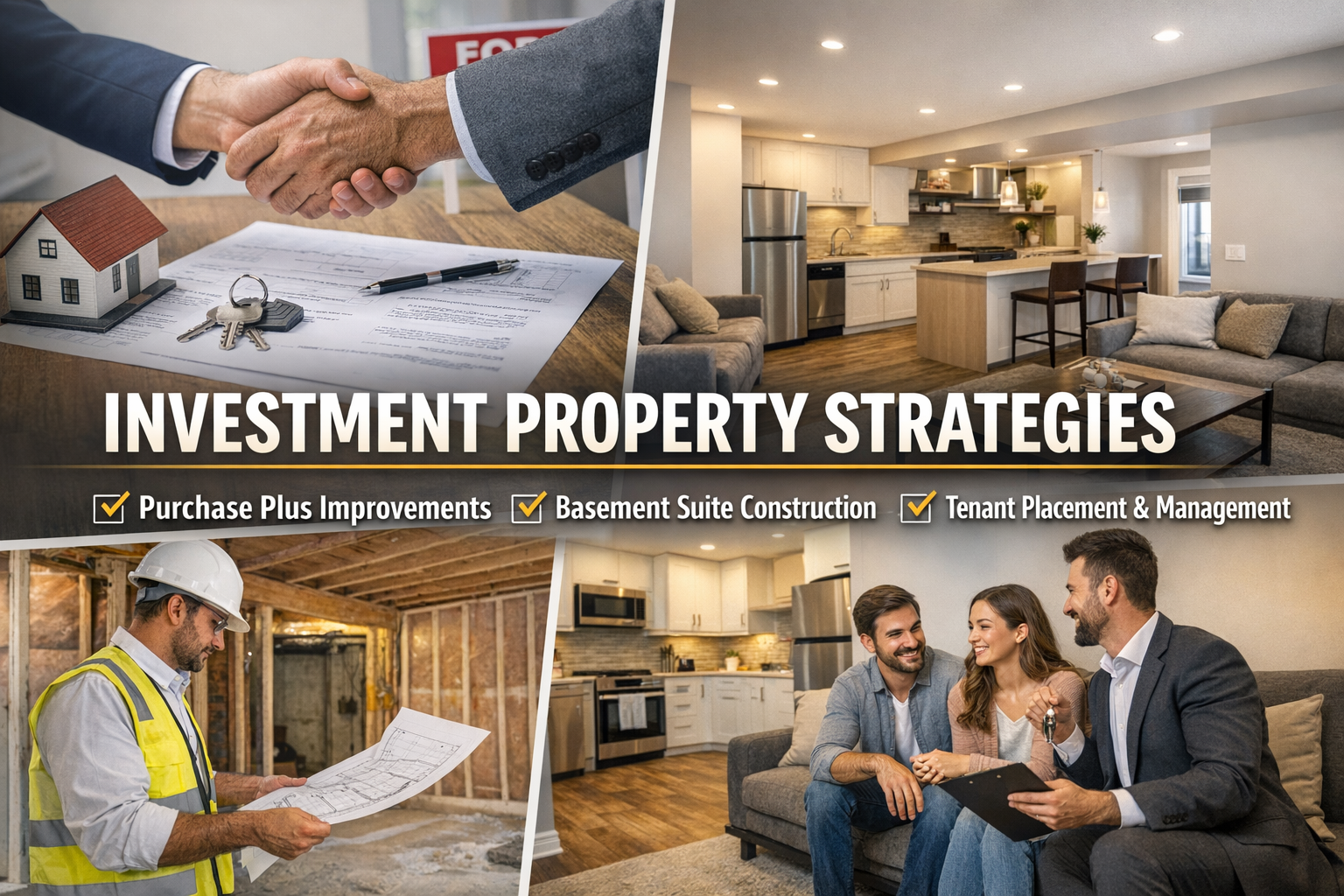
Building a legal basement apartment is one of the most effective ways to increase property value, improve monthly cash flow, and strengthen long-term financial stability. But unlike a simple basement renovation, creating a secondary suite requires strategic planning, zoning compliance, engineering, mechanical design, and a construction process that meets strict building code and fire safety standards. For homeowners looking to maximize their investment, understanding how these pieces fit together — from financing to design to final registration — is essential.
This guide is designed for homeowners who value clarity, long-term durability, and a renovation experience grounded in professional planning. We walk through the full journey: evaluating feasibility, developing the right layout for your target tenant, preparing technical drawings, securing permits, and building a safe, comfortable, and highly rentable suite. We also explain how the “Purchase Plus Improvements (PPI)” program can help finance the project efficiently, allowing homeowners to leverage lender-approved funds to create a legal unit with strong income potential.
At Aldo Homes, we support you through every stage — from investment strategy and design to engineering, permitting, construction, registration, and even tenant placement through our trusted partners. For homeowners seeking a reliable, fully insured, high-end renovation partner, we provide the expertise, coordination, and financial guidance needed to build a basement apartment that performs well, attracts quality tenants, and enhances the long-term value of your property.
📘 Table of Contents
🤝 2. Tenant Placement & Full Support From Aldo Homes
🧭 3. PreConstruction Stage: Preparing the Project Properly
📘 3.1 PrePurchase & Feasibility Stage
📗 3.2 Concept Development & Investment Strategy
📙 3.3 Technical Design & Engineering
📕 3.4 Municipal Approvals & Permitting
📒 3.5 PreConstruction Readiness
🏗️ 4. Construction Stage: Building a Safe, Comfortable & Rentable Apartment
🔧 4.1 Layout Maximization
⚙️ 4.2 Mechanicals
🧱 4.3 Insulation & Soundproofing
🎨 4.4 Drywall, Mudding, Sanding & Painting
🚪 4.5 Flooring, Tiling & Doors
🚿 4.6 Bathroom Installation
🧺 4.7 Washer & Dryer
🍽️ 4.8 Kitchen Installation
✨ 4.9 Finishings & Extras
📡 4.10 Smart Home Features
📝 4.11 Final Registration & TenantReady Turnover
🏛️ 4.12 City Inspections
💰 Financing Your Investment Property with the “Purchase Plus Improvements” Program
For buyers who cannot qualify for the full mortgage amount needed in their preferred neighbourhood — or who want to purchase a home and immediately add a legal rental suite — the Purchase Plus Improvements (PPI) program can be a highly effective financing strategy.
Through our partner mortgage broker, we help homeowners access:
-
Up to $200,000 added directly into the mortgage with no upfront renovation cost. The improvement funds are advanced after the work is completed and inspected, allowing you to build a legal rental unit without paying out of pocket.
-
Financing that covers both the basement apartment and optional upgrades to the main home, increasing overall property value and long-term equity growth.
-
Rental income underwriting using lender-approved methods, such as rental offset or rental add back, which improves your debt service ratios and helps you qualify for a higher mortgage.
-
A structured, lender-approved escrow process. The improvement funds are held in trust by the closing lawyer and released in three progress-based draws, each tied to completed work and City inspection results. At Aldo Homes, we can advance the initial construction costs because we are confident in our ability to complete the project efficiently and pass all required inspections.
-
A strong return on investment. The cost of creating a legal secondary suite is often exceeded by the combined benefits of:
- monthly rental cash flow
- increased appraised value
- improved resale potential
For many clients, the equity created by adding a legal secondary suite is significantly higher than the renovation amount financed through the PPI program.
🤝 Tenant Placement & Full Support From Aldo Homes
Planning and building a basement apartment is not just a renovation — it is a long‑term financial strategy. Homeowners pursue legal secondary suites to reduce mortgage payments, increase property value, and generate stable rental income. Our role is to support that strategy from the very beginning.
Whether this project is part of a new home purchase or a renovation of a property you’ve owned for years, our trusted realtor and mortgage‑broker partners help you secure the right financing solution — including the Purchase Plus Improvements program when applicable — and ensure the project is financially optimized from day one.
Once construction is complete, our realtor partner provides professional tenant placement, helping you secure a qualified tenant quickly so your suite begins generating income immediately.
This integrated approach — from feasibility and financing to construction, registration, and tenant placement — makes the entire process streamlined, predictable, and financially efficient.
🧭 Pre Construction Stage: Preparing the Project Properly
- Before any construction begins, the project must be evaluated, designed, engineered, and approved. This stage determines whether the basement apartment will be legal, safe, appealing, and financially worthwhile.
📘 1. Pre Purchase & Feasibility Stage
- This stage determines whether the property is a viable investment and what the likely return will be.
- A site visit helps assess the physical conditions of the basement — foundation condition, moisture levels, access routes for separate entrance and egress, ceiling heights, space distribution and room sizes, structural integrity, and any potential asbestos or lead risks.
- Zoning and property compliance reviews confirm whether a legal secondary suite is permitted in your municipality. Utility load assessments ensure the home’s electrical and water systems can support an additional unit.
- Income and ROI modelling is essential at this stage. Rent projections, payback period, cash flow, and neighbourhood rental demand help you understand whether the project makes financial sense.
This is the moment where you answer the question: Is this property worth converting?
📗 2. Concept Development & Investment Strategy
-
Once feasibility is confirmed, the next step is to determine the best use of the basement space and align the design with the rental market you want to attract. This is where strategic planning becomes essential. The layout, room count, and overall feel of the suite must match the expectations of your ideal tenant type. For example, a two-bedroom unit typically appeals to small families or couples with children, while a one-bedroom plus den is often preferred by young professionals, students, or retirees seeking a quiet, private living space. The design choices made at this stage directly influence rentability and long-term income performance.
-
Environmental testing — such as radon, mold, or asbestos/lead assessments — may be required depending on the age and condition of the home. Architectural floor plan options are then developed to maximize layout efficiency, ensure proper fire separation, and create a comfortable, functional living environment. Acoustic strategies are also considered to reduce noise transfer between the homeowner and tenant, improving privacy and overall satisfaction for both parties.
-
Interior finishes are selected with durability, maintenance, and rental appeal in mind. At the same time, a detailed project schedule and phasing plan are created, and the budget is validated to ensure cost control throughout the build.
-
Many of our clients have achieved above-market rental returns by incorporating a few key design considerations early in the process: a private entrance, large windows for improved natural light, an in-suite washer and dryer, strong internet connectivity, smart storage solutions, and essential safety features such as an egress window and hard-wired fire alarms. These elements elevate the suite to a “condo style” standard and help overcome the common perception of basement units as dark, cramped, or lacking amenities.
📙 3. Technical Design & Engineering
- This stage produces all technical documents required for permits and construction.
- Structural engineering drawings define beam sizes, load transfer points, and any required reinforcement.
- HVAC drawings ensure proper heating, cooling, and ventilation.
- Electrical layout plans determine lighting zones, outlets, and subpanel requirements.
- Plumbing permits are obtained if rough-ins are not already present.
- Surveying may be required for boundary or grading considerations.
- Trade walkthroughs ensure all contractors understand the design before construction begins, and provide useful feedback to be included in the design and permit application.
📕 4. Municipal Approvals & Permitting
- A legal basement apartment requires formal approval.
- This includes submitting the building permit application, paying permit fees, and responding to any City inquiries. If zoning relief is needed, a Minor Variance or Committee of Adjustment application may be required.
- In municipalities where secondary suite registration is mandatory, preparation for legal registration begins at this stage.
📒 5. Pre Construction Readiness
- Before construction starts, materials are sourced to avoid delays, insurance coverage is confirmed, and the budget is reviewed one final time. This ensures the project begins smoothly and stays on track.
🏗️ Construction Stage: Building a Safe, Comfortable & Rentable Apartment
🔧 1. Layout Maximization
- This stage prepares the physical space to support the best possible apartment layout.
- Demolition removes old finishes and exposes the structure. Structural work may include relocating or replacing columns, reinforcing joists, or installing new beams.
- A side entrance may be excavated and built, complete with drainage and concrete finishing.
- Windows are enlarged to meet egress requirements and improve natural light.
- Plumbing rough-ins are installed for the bathroom and kitchen.
- The floor is levelled before framing begins.
⚙️ 2. Mechanicals
- This stage installs the infrastructure that makes the unit functional and code compliant.
- Plumbing rough-ins include supply and drain lines, along with a backflow valve to reduce the risk of flooding.
- Electrical rough ins include wiring, fire proofing boxes, and a subpanel if needed.
- HVAC rough ins ensure proper heating, cooling, and air circulation. In some cases, a second furnace or alternative heating/cooling system is installed to comply with the new Building Code requirements.
🧱 3. Insulation & Soundproofing
- This stage dramatically improves comfort, even though it remains invisible once finished.
- For a comfortable stay, the floor needs a moisture barrier, rigid foam insulation, and a subfloor to prepare for vinyl flooring. Alternative techniques are considered and accounted for.
- The ceiling is insulated, gaps between floor joists and subfloor are filled to reduce footstep noise from above, and resilient channels are installed to significantly reduce sound transfer.
- Exterior walls are filled with fibreglass insulation and covered with a vapour barrier.
🎨 4. Drywall, Mudding, Sanding & Painting
- Drywall encloses the space, with fire-rated material on ceilings and moisture-resistant boards in the bathroom.
- Mudding and sanding create smooth surfaces, followed by primer and two coats of paint.
- Neutral, bright paint colours enhance natural and artificial lighting, making the space feel larger and more open. Washable, scrubbable paint ensures easy cleaning during tenant turnover and long term maintenance.
🚪 5. Flooring, Tiling & Doors
- Floor insulation and moisture protection are recommended to improve comfort and durability, especially since concrete slabs can become very cold during Ontario winters.
- Vinyl or laminate flooring is preferred for basement units due to higher moisture levels, while ceramic tile is ideal for entrances, bathrooms, and kitchen areas where water exposure is common.
- Interior doors, frames, trims, and baseboards are installed and painted, completing the finished look and ensuring consistent style throughout the unit.
🚿 6. Bathroom Installation
- A complete bathroom is installed, including a bathtub or shower, a water-saving toilet, a vanity, a faucet, a mirror, a cabinet, and hardware.
- See our post on how to renovate a bathroom, for additional technical details.
🧺 7. Washer & Dryer
- In suite laundry increases rental income and tenant satisfaction.
- Water lines, power supply, and venting are installed based on the chosen location.
🍽️ 8. Kitchen Installation
- A functional kitchen includes cabinets, a countertop, a sink, a faucet, a dishwasher, a backsplash, and appliances such as a fridge, a stove, and a vent.
- Our kitchen manufacturer partner provides the necessary cabinetry in either standard sizes or custom-built.
✨ 9. Finishings & Extras
- This includes electrical fixtures, potlights, premium hardware, exterior sensor lighting, and hard wired CO and smoke alarms.
📡 10. Smart Home Features
- Modern tenants value connectivity and safety. High-speed internet is achieved with a basement router or by hardwiring the internet lines.
- Additionally, water sensors, CO2 sensors, exterior cameras, and digital locks enhance the unit’s appeal.
📝 11. Final Registration & Tenant-Ready Turnover
- The secondary suite is officially registered, the unit has been professionally cleaned, and the space is ready for move-in.
🏛️ 12. City Inspections
- The City inspectors will perform a series of inspections at each mandatory stage. Aldo Homes and its partner engineers are available to assist as needed to ensure these inspections are passed.
📊 Basement Apartment Planning Overview Table
| Stage | Purpose | Key Considerations |
|---|---|---|
| PrePurchase & Feasibility | Determine viability & ROI | Zoning, moisture, utilities, rental demand |
| Concept Development | Define best layout & strategy | Fire code, acoustics, finishes, budget |
| Technical Design | Produce buildable plans | Structural, HVAC, electrical, plumbing |
| Permitting | Legal approval | Building permit, variances, registration |
| Layout & Structure | Prepare physical space | Entrance, windows, framing, leveling |
| Mechanicals | Install infrastructure | Plumbing, HVAC, electrical, backflow |
| Insulation | Comfort & safety | Soundproofing, moisture control |
| Finishes | Tenant appeal | Flooring, kitchen, bathroom, lighting |
| Smart Features | Modern convenience | Connectivity, sensors, security |
| Turnover | Final readiness | Cleaning, registration, occupancy |
🔍 Summary
What are the considerations for planning a new basement apartment?
Planning a basement apartment requires evaluating zoning, moisture, structural conditions, and utility capacity; designing a code‑compliant layout with proper egress, fire separation, and soundproofing; preparing engineering drawings; obtaining building permits; and completing all required City inspections. Construction includes structural work, mechanical systems, insulation, drywall, flooring, kitchen and bathroom installation, and smart‑home features. Final steps include legal registration, tenant placement, and preparing the unit for occupancy.
At Aldo Homes, we add value by managing this entire process end‑to‑end — from feasibility and financing to construction and tenant placement — ensuring your suite is legal, safe, and optimized for long‑term rental income. Our vertically integrated approach reduces risk, protects your investment, and delivers a predictable, high‑quality result that maximizes both cash flow and property value.
❓ FAQ (Expandable)
❓ FAQ
How does the Purchase Plus Improvements (PPI) program help finance a basement apartment?
The PPI program allows homeowners to add renovation funds directly into their mortgage at the time of purchase. The improvement funds are held in trust and released in progress-based draws after inspections, allowing the basement apartment to be built with no upfront renovation cost.
Why is a feasibility assessment required before planning a basement apartment?
Feasibility determines whether zoning permits a secondary suite, whether the available space is sufficient to build a Code-compliant unit where each room must meet minimum size requirements, whether utilities can support an additional unit, including a secondary HVAC system, and whether structural or access-related issues could affect the project’s viability or long-term ROI.
What factors determine whether a basement apartment is financially worthwhile?
Rent projections, cash flow, payback period, neighbourhood rental demand, and the cost of required upgrades all influence the overall return on investment. Features such as larger windows for improved natural light, in-suite washer and dryer for added comfort, and enhanced insulation in the floors, ceilings, and walls contribute to better tenant wellness and well-being. These upgrades help reduce turnover and increase demand for the unit.
Why is the desired tenant profile important during the design stage?
The layout and features must align with the expectations of the target tenant. For example, two-bedroom units appeal to small families, while one-bedroom plus den layouts tend to attract professionals or retirees. Location also influences the ideal design: proximity to universities may suggest layouts suited for students with predictable yearly turnover, while units near office buildings or hospitals may be better designed for single professionals. Our partner realtor provides the location and market analysis needed to define the best target tenant and the property’s future best-use positioning.
What engineering documents are required for a legal basement apartment?
Structural engineering drawings, HVAC plans, electrical layouts, plumbing permits, and, in some cases, surveying documents are required to meet building code and permit requirements.
When is a Minor Variance or Committee of Adjustment application needed?
If zoning relief is required for the secondary suite, the document notes that a Minor Variance or COA application may be necessary before permits can be issued.
What structural work may be required during construction?
Structural work may include reinforcing floor joists, replacing old brick columns or wood beams with new steel beams, steel posts, and proper footings, excavating for a side entrance, and enlarging windows to meet egress requirements. In some cases, to maximize the layout, it may be recommended to reconfigure the structural layout — for example, removing posts from the middle of a room and integrating them inside newly built walls.
Why is soundproofing emphasized in basement apartment construction?
Soundproofing improves comfort and privacy by reducing noise transfer between the homeowner and tenant. This is achieved through ceiling “safe and sound” insulation, filling gaps between floor joists, and installing resilient channels to support 5/8″ fire resistant drywall.
What mechanical systems must be installed to meet code?
Plumbing rough ins, a subpanel for new electrical circuits including the high voltage stove and dryer, fireproofing, and in some cases a second furnace or alternative heating/cooling system must be installed to comply with updated Building Code requirements.
What features increase rental appeal and help achieve above-market rents?
Secondary suites with private entrances, large windows, in-suite laundry, strong internet connectivity (ideally with a router hard-wired to the main modem), practical use of space to maximize storage, and safety features such as egress windows and hard-wired alarms all help increase rental appeal. We also recommend smart key locks, which allow access codes to be changed each time a tenant leaves — an especially important feature for properties used as Airbnb.
What happens during the final registration stage?
The secondary suite is officially registered with the municipality, the unit is professionally cleaned, and the space is prepared for the tenant’s move-in.
What inspections does the City perform during construction?
City inspectors conduct mandatory inspections at each major stage of construction, typically including framing, plumbing, insulation, and final occupancy. Electrical inspections are performed separately by the Electrical Safety Authority (ESA), not by City inspectors. Aldo Homes and its partner engineers assist throughout the process to ensure all inspections are passed successfully.
📚 Sources (Expandable)
📚 Sources
Below is the list of official sources used to produce this page.
View Sources
| Source | Link | What It Contributed |
|---|---|---|
| Ontario Building Code (OBC) | https://www.ontario.ca/laws/regulation/120332 | Ceiling height, fire separation, egress, HVAC, plumbing, structural requirements |
| Ontario Fire Code | https://www.ontario.ca/laws/regulation/070213 | Smoke/CO alarms, fire-rated assemblies, fire safety obligations |
| City of Toronto – Secondary Suite Requirements | https://www.toronto.ca/community-people/housing-shelter/ | Registration rules, zoning permissions, permit process |
| Electrical Safety Authority (ESA) | https://esasafe.com | Electrical inspections, subpanel requirements, wiring standards |
| Residential Tenancies Act (RTA) | https://www.ontario.ca/laws/statute/06r17 | Tenant rights, habitability, landlord obligations |
| CMHC – Purchase Plus Improvements Program | https://www.cmhc-schl.gc.ca | PPI financing rules, improvement fund release process |
| City of Toronto – Building Permits | https://www.toronto.ca/services-payments/building-construction/ | Permit fees, inspection stages, zoning compliance |
| Committee of Adjustment (COA) | https://www.toronto.ca/city-government/planning-development/ | Minor variance process for zoning relief |
| Ontario Plumbing Code | https://www.ontario.ca/laws/regulation/031332 | Backflow, venting, drainage requirements |
| Industry Engineering Standards | https://www.peo.on.ca/knowledge-centre/practice-advice-resources-and-guidelines/practice-guidelines | Beam sizing, load transfer, structural reinforcement |
| HVAC Design Guidelines (ASHRAE aligned) | https://www.ashrae.org | Ventilation, heating/cooling load calculations |
| Real Estate Rental Market Data | CMHC www.viewit.ca https://www.realtor.ca/mls | Rent projections, tenant placement practices |
⚖️ Disclaimer
This guide provides general information only and may not reflect the specific requirements of every municipality or property. Legal secondary suites must be designed, engineered, and constructed in compliance with the Ontario Building Code and all applicable regulations. For project-specific guidance, Aldo Homes is available to review your plans and support you through the full process.