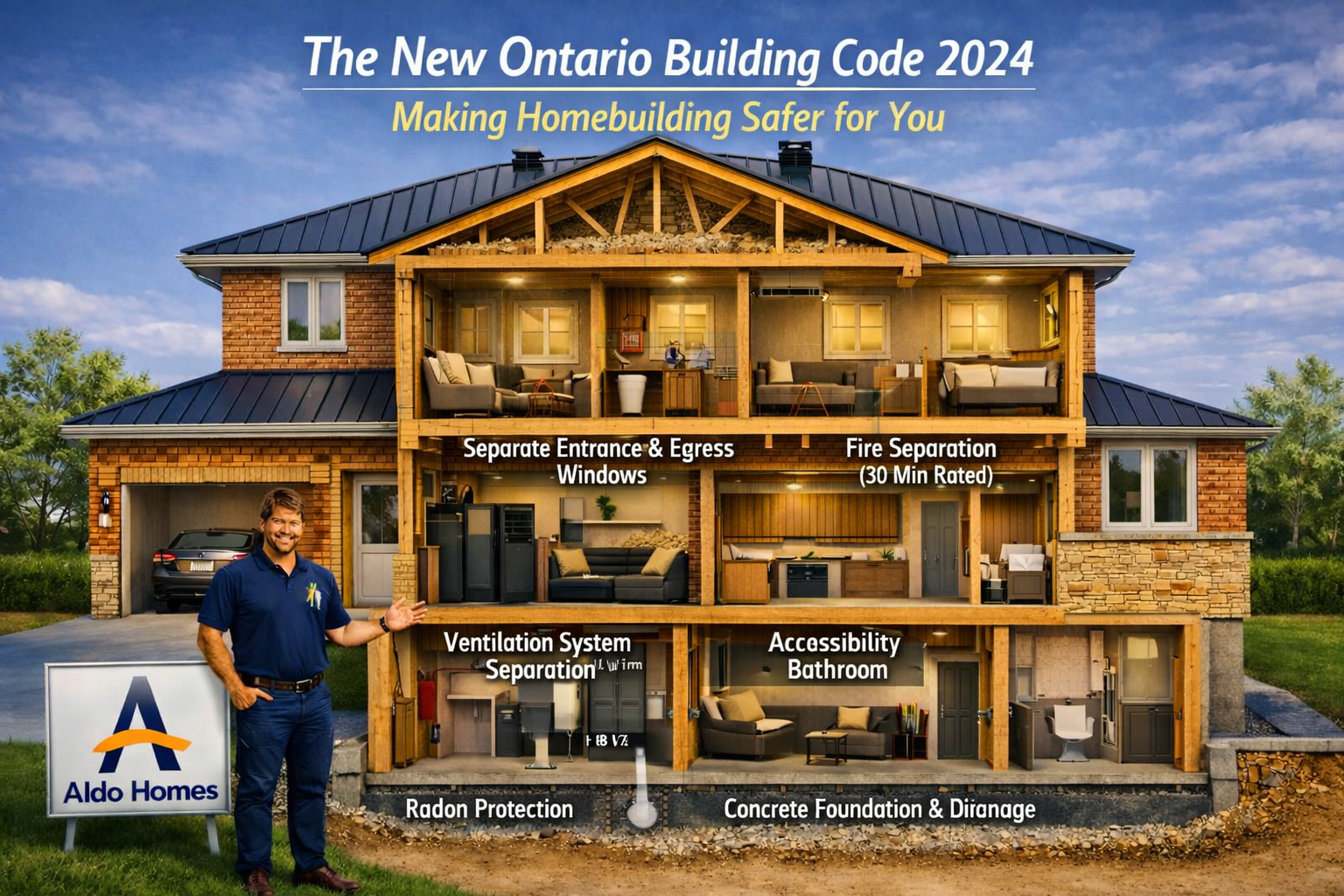
Ontario’s 2024 Building Code (OBC) came into effect on January 1, 2025, replacing the 2012 edition after more than a decade. With over 2,400 technical changes — including the elimination of at least 1,730 variations between provincial and national requirements — this is the most significant overhaul in the Code’s 50-year history. Whether you’re planning a renovation, building a secondary suite, or simply keeping your property compliant, this guide breaks down exactly what changed and what it means for Ontario homeowners.
📘 Table of Contents
🔄 2. Key Changes at a Glance — 2012 vs. 2024 Comparison
🔧 3. HVAC Separation Rules for Secondary Suites
🏗️ 4. Basement Apartment and Secondary Suite Requirements
☢️ 5. Radon Protection and Soil Gas Control
🔔 6. Carbon Monoxide and Smoke Alarm Updates
♿ 7. Accessibility and Universal Design
🌬️ 8. Ventilation System Reorganization
🔥 9. Fire Safety Enhancements
🏡 10. What This Means for Your Project
❓ 11. Frequently Asked Questions
📚 12. Sources
📅 1. Timeline and Transition Rules
The transition from the 2012 OBC to the 2024 OBC followed a phased schedule. The table below outlines which code applies based on when your permit application was submitted.
| Date | What Applies |
|---|---|
| Until December 31, 2024 | All permit applications submitted under the 2012 OBC |
| January 1 – March 31, 2025 | Permits may be submitted under either the 2024 OBC or the 2012 OBC (if working drawings were substantially complete by Dec 31, 2024) |
| April 1, 2025 onward | All new permit applications must use the 2024 OBC |
| 💡 Aldo Homes Tip: If your permit was issued under the 2012 Code, construction must have commenced within six months of permit issuance for the transition rules to apply. After that window, the 2024 Code governs, and a new building permit has to be issued. |
|---|
🔄 2. Key Changes at a Glance — 2012 vs. 2024 Comparison
The following table summarizes the most impactful changes between the two editions of the Ontario Building Code, as they relate to basement apartments or interior renovation projects.
| Topic | 2012 OBC | 2024 OBC |
|---|---|---|
| Basement ceiling height (secondary suites) | 2.1 m (6'11") for new construction | 1.95 m (6'5") — reduced threshold for secondary suites |
| Clearance under beams/ducts | Variable by application | 1.85 m (6'1") minimum |
| HVAC duct sharing (new builds) | Indirect prohibition via Part 6 reference | Explicit prohibition in Part 9, Clause 9.33.1.1.(3) |
| HVAC duct sharing (existing conversions) | Limited guidance | Part 11 permits shared systems for up to 4 units with conditions |
| Radon protection | General soil gas measures | Mandatory sub-slab depressurization rough-in for all new homes |
| CO alarm requirements | Residential occupancies only | Expanded to care occupancies and some commercial buildings |
| Grab bar blocking | Not explicitly required | Mandatory reinforcement in new bathroom walls for future grab bars |
| Ventilation categories | Type I, Type II, etc. | Reorganized into "heating season" and "non-heating season" ventilation |
| Barrier-free entrances | Select entrances | All pedestrian entrances must be barrier-free accessible |
| Fire protection (large buildings) | Ontario-specific provisions | Harmonized with National Building Code (standpipe, fire alarm, sprinkler) |
| Farm buildings | Separate code framework | New Group G occupancy classification (Div. 1–4) within the OBC |
| National Code harmonization | ~1,730+ technical variations | Eliminated or aligned to reduce interprovincial differences |
🔧 3. HVAC Separation Rules for Secondary Suites
New Construction — Clause 9.33.1.1.(3)
The 2024 OBC now states explicitly:“Air duct distribution systems serving one of the dwelling units in a house with a secondary suite shall not be directly interconnected with other parts of the house.”
In practical terms, this means:
- No shared ductwork between the main unit and the secondary suite
- No shared furnace serving both units through connected ducts
- Each dwelling unit requires its own independent air system — separate supply, return, and air handling equipment
- Compliant options include: independent furnaces with separate duct runs, or ductless mini-split systems for the suite
Why this matters: Shared duct systems allow smoke, carbon monoxide, and odours to transfer between units. The 2024 Code makes this a fire and life-safety issue, not just a comfort preference.
How This Differs from the 2012 Code
Under the 2012 OBC, there was no explicit Part 9 clause prohibiting shared ducts. The requirement came indirectly through Part 6, Article 6.2.3.9.(1), which stated “Air from one suite shall not be circulated to any other suite.” The 2024 Code removes that ambiguity by placing the prohibition directly in Part 9 where residential designers and builders reference it most.
Existing Buildings — The Part 11 Exception
Part 11 of the 2024 OBC provides a conditional allowance for existing houses being converted into multiple dwelling units (up to four units). This recognizes that full HVAC separation in older homes may be prohibitively expensive or structurally impractical. However, the allowance comes with conditions — consult your local building department and a qualified HVAC designer to confirm eligibility.
| Scenario | HVAC Separation Required? |
|---|---|
| New-build house with secondary suite | Yes — fully independent systems required |
| Major renovation adding a secondary suite | Yes — Clause 9.33.1.1.(3) applies |
| Existing home converted to 2–4 units (Part 11) | Conditional — shared systems may be permitted |
🏗️ 4. Basement Apartment and Secondary Suite Requirements
Minimum Requirements Checklist
| Requirement | 2024 OBC Standard |
|---|---|
| Minimum floor area (bachelor/studio) | 13.5 m² (145 sq ft) |
| Ceiling height — habitable rooms | 1.95 m (6'5") |
| Ceiling height — under beams, ducts, stairs | 1.85 m (6'1") |
| Fire separation from main dwelling | 30-minute rated walls; 15-minute ceiling |
| Egress window | Required in every bedroom; minimum unobstructed opening per OBC 9.9.10 |
| Separate entrance | Required for all legal secondary suites |
| Kitchen | Full kitchen with cooking facilities required |
| Bathroom | Full bathroom required |
| Smoke alarms | Interconnected with the main dwelling unit |
| CO alarms | Required where fuel-burning appliances, fireplaces, or storage garages are present |
| HVAC | Independent system required (new construction); see Part 11 for conversions |
| Door viewer or camera | Dwelling unit doors must include a peephole, glazing, sidelight, or electronic doorbell camera |
Room Size and Window Area Minimums
| Room Type | Minimum Floor Area | Minimum Window Glass Area |
|---|---|---|
| Living room | 13.5 m² (145 sq ft) | 0.675 m² (7.25 sq ft) |
| Dining room | 7 m² (75 sq ft) | 0.35 m² (3.75 sq ft) |
| Principal bedroom (with closet) | 8.8 m² (95 sq ft) | 0.22 m² (2.5 sq ft) |
| Principal bedroom (without closet) | 9.8 m² (105 sq ft) | 0.245 m² (2.5 sq ft) |
| Second bedroom (with closet) | 6 m² (65 sq ft) | 0.15 m² (1.9 sq ft) |
| Second bedroom (without closet) | 7 m² (75 sq ft) | 0.175 m² (1.9 sq ft) |
| Kitchen (1-bedroom suite) | 3.7 m² (40 sq ft) | Windows not required |
| Kitchen (2-bedroom suite) | 4.2 m² (45 sq ft) | Windows not required |
| Bathroom / utility rooms | No minimum | Windows not required |
Egress Window Requirements
Every bedroom in a basement suite must have an emergency escape window (or door) that meets the OBC’s minimum clear opening dimensions. The measurement is the actual unobstructed opening when the window is fully open — not the glass area or frame size. If a basement has a walkout door at grade, it may serve as the emergency exit provided the path from the bedroom to the door meets travel distance requirements and does not pass through a furnace room or storage area.
| 💡 Aldo Homes Tip
Measure ceiling height from the top of the concrete slab to the underside of the joists, then subtract the thickness of your finished flooring (typically 1–2 inches, or more if rigid foam insulation is added) and your finished ceiling (minimum ½ inch drywall). If the resulting height is below 1.95 m, underpinning may be required — a process that generally ranges from $40,000 to $80,000+ in Ontario. |
|---|
☢️ 5. Radon Protection and Soil Gas Control
The 2024 OBC introduces significantly strengthened requirements for radon and soil gas protection in new residential construction:
- Soil gas barriers are now specifically required for all assemblies in contact with the ground. Joints, penetrations, and perimeters must be sealed.
- A concrete slab alone is no longer considered an acceptable air barrier against soil gas. A separate membrane air barrier is required in typical residential basements.
- A sub-slab depressurization system rough-in is now mandatory for all new Part 9 residential buildings. This includes a pipe routed from beneath the slab to allow future installation of a radon mitigation fan if elevated levels are detected.
- New appendix notes (A-9.13.4.) provide examples and guidance on acceptable rough-in configurations.
Key code references: Subsection 9.13.4., Sentences 9.13.4.2.(1) and (2), Article 9.13.4.3., and Supplementary Bulletin SB-9.
🔔 6. Carbon Monoxide and Smoke Alarm Updates
The 2024 OBC expands carbon monoxide and smoke alarm requirements beyond the residential scope of the 2012 edition:
- CO alarms are now required in care occupancies (such as long-term care facilities) and in some commercial buildings with fuel-burning appliances.
- In residential settings, CO alarms must be installed adjacent to each sleeping area and on each storey without sleeping areas, where fuel-burning appliances, fireplaces, or attached storage garages are present.
- Smoke alarms must include a visual component conforming to NFPA standards on every floor and in every sleeping room of residential buildings.
♿ 7. Accessibility and Universal Design
The 2024 OBC makes substantial advances in accessibility requirements for both large buildings and residential construction:
- All pedestrian entrances to large buildings must be barrier-free accessible.
- At least 15% of suites in new multi-unit residential buildings must include basic accessibility features (barrier-free path of travel and doorway into kitchen, bedroom, living room, and full bathroom).
- Grab bar blocking: New walls around fixtures in the main bathroom of a dwelling unit must now be reinforced with blocking to support future installation of grab bars at the toilet, shower, and bathtub (OBC 9.5.2.4.).
- Visual fire safety devices must be installed on every floor and in every sleeping room of residential buildings.
🌬️ 8. Ventilation System Reorganization
The 2024 OBC introduces a complete restructuring of how residential ventilation is categorized and specified:
The old Type I, Type II categories for houses are eliminated.
- Ventilation requirements are now split into “heating season ventilation” (9.32.2.) and “non-heating season ventilation” (9.32.3.).
- New prescriptive requirements for make-up air are provided (9.32.3.8.).
- An additional 15 pages of appendix notes show acceptable arrangements of equipment for different mechanical ventilation approaches.
- Section 9.33 (Heating and Air Conditioning) has been expanded to include residential duct system requirements previously found in Part 6, plus additional requirements for radiators, convectors, chimneys, piping, and refrigeration systems.
🔥 9. Fire Safety Enhancements
The 2024 OBC updates and harmonizes fire safety provisions with the National Building Code:
- Updated requirements for standpipe systems, fire alarm systems, and sprinkler systems.
- Enhanced means of egress requirements.
- Updated regulations for mezzanines.
- Guidelines for roof-mounted solar panels and their impact on fire safety.
For residential secondary suites, the fire separation requirements remain at 30-minute-rated walls and 15-minute ceiling assemblies, with smoke alarms interconnected between the suite and the main dwelling.
🏡 10. What This Means for Your Project
Every project type is affected differently by the 2024 OBC. Use the table below to identify the key impacts for your situation.
| If You're Planning To… | Key 2024 OBC Impacts |
|---|---|
| Build a new home | Radon rough-in required; grab bar blocking in bathrooms; new ventilation categories |
| Add a basement suite (new build) | Independent HVAC system mandatory; 1.95 m ceiling height; egress windows in all bedrooms; separate entrance |
| Convert an existing home to multi-unit | Part 11 may permit shared HVAC for up to 4 units; reduced ceiling height threshold of 1.95 m |
| Renovate an older home | If no permit change, existing code may still apply — verify with your local building department |
| Install or replace a furnace | If serving a secondary suite, ductwork must be fully separated (new construction) |
💡 Aldo Homes Tip: Always confirm your project’s code path with your local Chief Building Official before construction begins. Transition rules, Part 11 provisions, and municipal zoning bylaws can all affect which requirements apply to your specific build.
❓ 11. Frequently Asked Questions
When did the 2024 Ontario Building Code take effect?
The 2024 OBC came into effect on January 1, 2025. A grace period allowed permit applications under the 2012 Code until March 31, 2025, provided working drawings were substantially complete by December 31, 2024. As of April 1, 2025, all new permit applications must use the 2024 Code.
Can I still share a furnace between my main home and a basement suite?
For new construction or major renovations: No. Clause 9.33.1.1.(3) explicitly prohibits shared duct systems between a dwelling unit and a secondary suite. Each unit needs its own independent HVAC system. For existing home conversions (Part 11): Possibly. Part 11 provides a conditional allowance for shared HVAC in existing buildings being converted to up to four dwelling units, recognizing the cost and structural challenges of full separation in older homes.
What is the minimum ceiling height for a legal basement apartment?
The 2024 OBC requires a minimum ceiling height of 1.95 m (6’5”) in habitable rooms of a secondary suite, and 1.85 m (6’1”) under beams, ducts, and stairs. Measure from the finished floor to the finished ceiling — not from the concrete slab to the joists.
Do I need a separate entrance for a basement apartment?
Yes. A separate entrance from the main dwelling is required for all legal secondary suites under the 2024 OBC.
What are the new radon requirements?
All new Part 9 residential buildings must now include a rough in for a sub slab depressurization system — a pipe from beneath the slab that can be connected to a radon mitigation fan if elevated radon levels are detected after construction. Soil gas barriers with sealed joints, penetrations, and perimeters are also required for all assemblies in contact with the ground.
Are grab bars now required in new homes?
Not grab bars themselves, but blocking to support their future installation. New walls around bathroom fixtures (toilet, shower, bathtub) must be reinforced so grab bars can be added later without tearing into the wall.
Does the 2024 Code apply to my existing home if I'm not renovating?
No. Existing buildings are not retroactively affected unless an extensive renovation, change of use, or new construction is planned. However, the Ontario Fire Code may independently require updates to smoke and CO alarms.
What changed for ventilation systems?
The old “Type I, Type II” house categories have been eliminated. Ventilation is now organized by heating season and non-heating season requirements, with new prescriptive rules for make-up air and expanded appendix guidance.
Where can I get a free copy of the 2024 Building Code?
The digital 2024 Building Code Compendium is available as a free download from Publications Ontario at www.ontario.ca/buildingcode
📚 12. Sources
| Source | Link | What It Contributed |
|---|---|---|
| Ontario Ministry of Municipal Affairs and Housing — 2024 Ontario Building Code | https://www.ontario.ca/page/2024-ontario-building-code | Official 2024 OBC release, structure, and regulatory framework |
| Ontario Ministry of Municipal Affairs and Housing — Building Code Updates | https://www.ontario.ca/page/building-code-updates | Summary of changes, transition rules, and update bulletins |
| Ontario Regulation 163/24 (and amendments) | https://www.ontario.ca/laws/regulation/240163 | Legal regulation text governing the 2024 OBC |
| 2024 OBC Technical Bulletins (CodeNews) | https://www.ontario.ca/page/building-code-updates | Clarifications, technical interpretations, and implementation notes |
| Accessibility in Ontario’s Building Code | https://www.ontario.ca/page/accessibility-ontarios-building-code | Accessibility requirements, barrierfree design rules |
| OBOA — HVAC for Dwelling Units | https://bcas.oboa.on.ca/support/solutions/articles/70000666277-hvac-for-dwelling-units | HVAC separation guidance and technical interpretations |
| OBOA — Soil Gas & Radon Requirements | https://bcas.oboa.on.ca/support/solutions/articles/70000680408-soil-gas-barrier-and-radon-requirements-for-the-2024-obc | Radon, soil gas barrier, and depressurization roughin requirements |
| Town of Collingwood — Radon Guide | https://www.collingwood.ca/media/file/2024-obc-radonpdf | Municipal radon compliance summary |
| HCRA — Secondary Suites Updates | https://www.hcraontario.ca/resources/secondary-suites-2024-code-updates/ | Secondary suite requirements and homeowner guidance |
| Publications Ontario — 2024 OBC Compendium | https://www.ontario.ca/page/2024-ontario-building-code | Free digital download of the full 2024 OBC |
| Town of Collingwood — Homeowner’s Guide to Secondary Suites | https://www.collingwood.ca/media/file/updated2024obcpart11aautables-002pdf-0 | Part 11 guidance for existing home conversions |
⚖️ Disclaimer
© 2026 Aldo Homes. This page is provided for general information purposes only. It highlights select changes to the Ontario Building Code and is not intended as legal or technical advice. Homeowners — and contractors referencing this material for their own understanding — should consult the official 2024 Building Code Compendium and their local Chief Building Official for project-specific requirements.